
Triple Net Investing: What a High Cap Rate Is Really Signaling
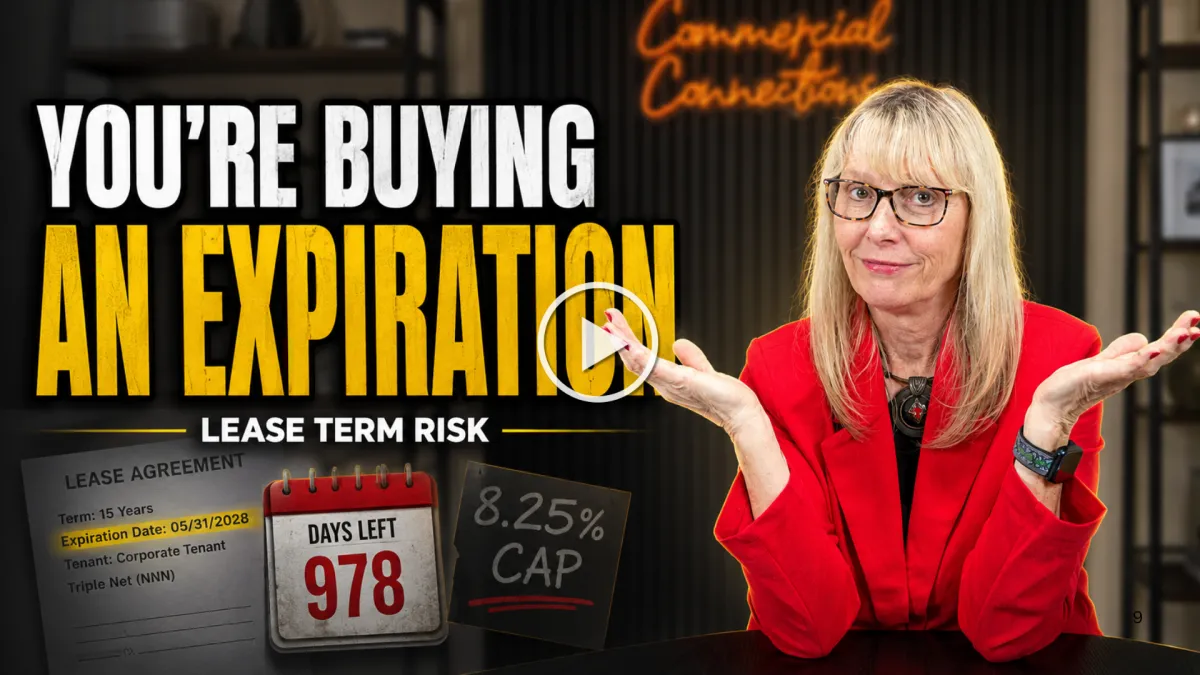
If you are evaluating triple net lease properties right now, this is the conversation worth having before you make an offer.
Most investors see a higher cap rate and assume they found a better deal. What they have actually found is a risk the market is pricing in. And if they do not know what that risk is, it does not show up at closing — it shows up the day the lease gets shorter and the exit gets harder.
What Cap Rate Is Actually Telling You
Cap rate is the relationship between income and price. A higher cap rate means a lower price relative to the income. A lower cap rate means a higher price relative to the income. They are the inverse of each other.
But the part that matters most is this: the market prices risk through the cap rate. When you see a higher cap rate on a triple net deal, the first question should not be “how do I get this under contract.” It should be: what risk is the market pricing into this, and do I understand it well enough to own it?
Three Numbers That Tell Most of the Story
You do not need to research every local market to screen a deal. Use the offering memorandum. Focus on three numbers: remaining years on the lease, actual annual rent, and the market cap rate implied by the asking price.
Then ask yourself one question before going further: what is my exit plan, and who is the buyer when I am ready to sell?
Here is the truth that changes how you evaluate every deal: no one can guarantee a tenant will renew a lease. You are not buying a promise. You are buying an income stream and a contract for a defined period of time. Your job is to decide whether the price matches the amount of time you are actually buying.
Five Warning Signs in a Triple Net Deal
Warning Sign 1: Lease Term Is Getting Short
Lease term is the single biggest driver of perceived certainty in a NNN deal — and the one most buyers underweight. Check the lease term and expiration date first. If you are within five years of expiration, you are approaching a decision point. The tenant controls whether they renew. You do not.
That does not make the deal bad. It means the price has to reflect that uncertainty.
I have seen investors build strong retirement portfolios buying properties with short remaining terms. They went in with a clear strategy: buy multiple properties at lower price points, hold through the decision window, and ride the wave rather than panic and sell off. That approach can work — but only when you understand exactly what you are doing and why.
The trap I see most often is the opposite: someone buys a deal with six years remaining because the cap rate looks attractive, holds for three years, and is now trying to sell a property with three years left on the lease. The buyer pool is small at that point. Pricing softens. You can lose money on the exit even if the income looked solid on day one.
Warning Sign 2: Thin Market, Limited Buyers
Liquidity means how easy it is to sell this asset to the next buyer. A property in a major market with a long remaining lease tends to attract multiple competing buyers. A property in a smaller or thinner trade area — a smaller town with limited retail density — can still be a solid investment, but it typically has a narrower buyer pool.
Fewer buyers means the market demands a discount. That discount shows up as a higher cap rate at acquisition and a higher cap rate when you sell. If you are not being compensated adequately for that at entry, you will feel it at exit.
Warning Sign 3: The Story Is Only About the Yield
Any time a deal is presented primarily around the cap rate — and the conversation does not quickly move to lease term, renewal options, location fundamentals, and exit strategy — slow down.
A good deal can be explained from more than one angle. What is the remaining term? What are the extension options? How long has the tenant been at this location? What does the trade area look like within three and five miles? If those answers are hard to get or vague when you ask, that is information.
Warning Sign 4: Lease Structure Has Friction
Most triple net leases are straightforward, but the basics are worth confirming before you go further. How much time is left on the primary term? Are there options to extend, and on what terms? Do rent increases occur, and when? Is it a true triple net where the landlord carries no responsibility for taxes, insurance, maintenance, the parking lot, and the roof?
You do not need to litigate every clause during initial screening. But you should know what you are buying and whether any structural nuances would give a future buyer pause — because that future buyer is the person you are eventually selling to.
Warning Sign 5: Bond Pricing on Non-Bond Risk
Some investors approach triple net the way they approach a bond — predictable income, low risk, set it and forget it. Triple net is not a bond. It is a real estate asset with a lease attached, and when something changes — term shortens, tenant struggles, market thins — it behaves like real estate.
If a deal is priced tightly but the lease term is short or the buyer pool is limited, you are paying bond pricing for non-bond risk. That is where investors get hurt — not from the income during the hold, but from the pricing at the exit.
When a Higher Cap Rate Actually Makes Sense
A higher cap rate is not automatically the wrong answer. It can be the right move when you are intentionally buying a shorter-term deal because you want higher yield and you have a clear exit plan, when you are comfortable holding through the next decision point and have the patience and reserves to do it, or when the deal is genuinely priced to compensate you for the uncertainty you are taking on.
The difference between a disciplined higher-yield buy and a mistake that looks the same on paper is almost entirely in whether the investor understood what they were choosing.
The Three-Timeline Test
Before committing to any triple net deal, run this test. It takes less than a minute and it will change how you see every offering.
Today: What is the actual rent? What is the cap rate? How much lease term is left?
Your hold period: If you hold for three years, how much term is left? Five years?
Your exit: At that future point, would a buyer feel like they are buying stability — or buying into an expiring event?
If the deal only works if you assume a clean renewal, that is a red flag. Your underwriting has to hold up even without a perfect outcome.
A Personal Note
I own a Dollar General. I bought it because I wanted simplicity and predictability — income that did not depend on constant management decisions. That kind of stability is real, and it is exactly what a well-structured NNN deal can provide.
But the way you get it is not by chasing the highest cap rate. It is by buying the right amount of term for your goals and paying the right price for the risk you are actually taking on.
If you are evaluating a triple net transition as part of a 1031 exchange or a strategic exit from multifamily, I’m glad to walk through the underwriting with you.
Request your Eugene–Springfield Apartment Market Snapshot or your University of Oregon Area Apartment Market Snapshot to see what your current asset is worth and what the transition options actually look like from where you stand.
— René Nelson, CCIM
Principal Broker & Owner, Pacwest Commercial Real Estate
René Nelson, CCIM, is the Principal Broker and Owner of Pacwest Commercial Real Estate, a boutique brokerage in Eugene, Oregon specializing in multifamily and investment property. Licensed since 1989 and CCIM-designated since 2008 — a credential held by fewer than 10% of commercial brokers nationwide — she has guided private and institutional clients through complex 1031 exchanges and strategic exits across the Eugene–Springfield and University of Oregon markets for more than three decades. A multiple-time CCIM Transaction of the Year recipient (2013, 2015, 2020, 2021) and winner of the 2024 Best Overall Transaction of the Year, René is known for turning complex transactions into confident, profitable outcomes — helping owners move from hands-on management to hands-free income while protecting the equity and legacy they’ve spent a lifetime building. The resources shared here are for informational purposes only and are not financial, tax, or legal advice. Every property and owner’s situation is unique. For guidance tailored to your goals, connect with me directly and we’ll walk through your options together.
Featured
Insights. Advice. Results.
Why I Do This Work: My Philosophy on Multifamily Real Estate and Legacy
René Nelson, CCIM, on the philosophy behind Pacwest Commercial Real Estate — how she helps Eugene multifamily owners sell, exchange, and build lasting legacy.
CCIM Designee since 2008 • Licensed since 1989 •
2024 Best Overall Transaction
© 2026 Pacwest Commercial Real Estate, Inc.
Terms & Conditions | Privacy Policy