
Dollar General NNN Properties: What Small Landlords Need to Know Before They Exchange
There’s a moment a lot of long-time landlords reach where the property still produces income, but ownership itself gets heavier. Repairs take more time than they used to. Insurance costs move in one direction. Tenant turnover continues. Refinance decisions get tighter.
When that moment arrives, some owners start looking at Dollar General NNN properties. I understand the appeal. A triple-net lease can pull a significant amount of management load off the owner. The tenant carries more of the operating responsibility. The owner collects rent, monitors the lease, and thinks about basis and exit timing instead of maintenance calls and vacancy.
But NNN is not a guaranteed simplification. It is a different kind of underwriting. And before any Oregon multifamily owner moves equity into a Dollar General through a 1031 exchange, there are a few things worth understanding clearly.
The Property That Came Up in This Conversation
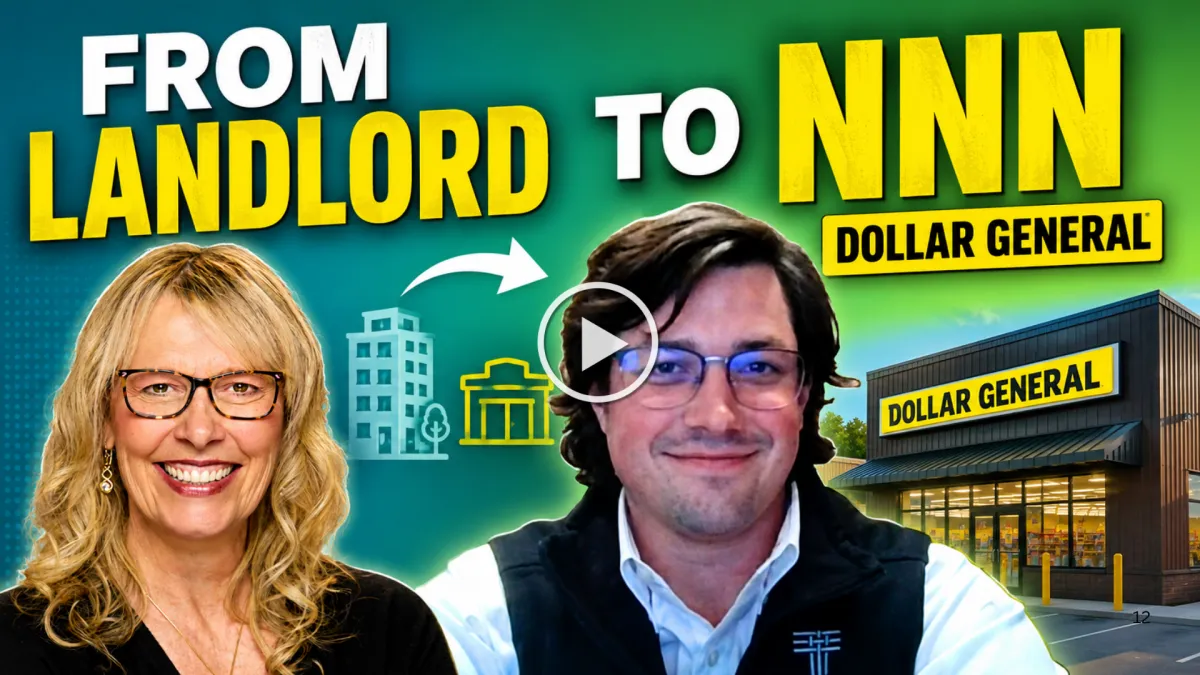
I recently sat down with Cody Crist and Matt Davis of Trinity Real Estate Investment Services to talk through exactly this kind of decision. The example they used was real — an owner who sold multifamily in Oregon and exchanged into a Dollar General in Illinois. The property produces about $103,500 in annual rent and has roughly nine years left on the lease.
That lease term is the first number that matters.
Nine years is still a marketable position. Buyers will look at it. But they will not treat it the same way they treat a fresh 15-year lease. The longer the remaining term, the easier the property is to finance, the broader the buyer pool, and the stronger the pricing. As years come off that clock, those dynamics shift.
Owners who are thinking about a future exit need to factor that in now, not when they’re already 12 years into a 15-year lease with three years remaining and a narrower market waiting for them.
What Cap-Rate Resets Actually Mean for Owners
The conversation also covered something I think a lot of owners underestimate: cap-rate resets.
Owners who acquired Dollar General properties in 2020 through 2022 may still own solid, cash-flowing assets. But if they pulled a current valuation today, the number might be lower than what they paid — not because the property deteriorated, but because the market repriced. Cap rates moved. What sold at a 5 cap three years ago may be priced closer to a 6.5 or 7 cap today, and that shift in the rate compresses the value even when the rent stays the same.
That does not mean those owners should sell. It means they need to run an honest comparison. What does the current asset look like relative to today’s replacement options? What is the realistic exit value now versus in five years? Is holding the right answer, or is there a better use of that equity?
Those are the questions a good analysis has to answer before anyone makes a move.
The Inventory Question Worth Watching
Dollar General has been building fewer new stores than in prior years. That matters in two directions.
On one hand, slower new construction can support demand for the existing inventory. Buyers looking for Dollar General NNN exposure have fewer brand-new options to choose from, which keeps attention on properties like the one described above.
On the other hand, it makes 1031 replacement inventory harder to find. If someone sells a multifamily property in Oregon and wants to exchange into a Dollar General, they are competing in a market with limited supply and firm timelines. The 45-day identification window does not slow down because good options are scarce.
Having a clear sense of what you are looking for — and what you will not accept — before you close your sale is not optional. It is what keeps a 1031 exchange from becoming a pressured decision made under deadline.
What Small Landlords Actually Need to Underwrite
For the Oregon apartment owner who is weighing this kind of transition, the checklist is straightforward, even if the decisions are not.
Lease term is the starting point. How many years remain? Is there a renewal option, and on what terms? What does the rent look like in year ten if the tenant exercises that option at a lower rate?
Rent level and store performance both matter. A Dollar General paying above-market rent on a low-volume store is a different risk profile than one paying market rent on a high-performing location. Understanding the store’s sales history gives you a clearer picture of whether the tenant is likely to stay or walk at renewal.
Cap rates and buyer demand determine what your exit looks like. Who buys a Dollar General with eight years left on the lease in your specific market? What cap rate are they underwriting? That answer tells you what the property is worth today and what it will be worth when you need to sell.
And basis — what you paid and what you carried in from the exchange — shapes every downstream decision about timing, tax exposure, and next moves.
The Question That Matters Most
NNN ownership can reduce day-to-day operations. It does not remove the responsibility of owning a real estate asset with a finite lease, a specific tenant, and a market that prices that asset based on factors beyond your control.
The right question is not whether the property is passive. The right question is whether the decision protects the equity you spent years building.
If you are a multifamily owner in the Eugene–Springfield area thinking about a 1031 exchange into NNN property, I’m glad to walk through the numbers with you. We can look at what your current asset is worth, what replacement options are realistic, and whether this kind of transition actually serves your goals — or whether a different path makes more sense.
Schedule a confidential Pinpoint Price Evaluation and we’ll start there.
— René Nelson, CCIM
Principal Broker & Owner, Pacwest Commercial Real Estate
René Nelson, CCIM, is the Principal Broker and Owner of Pacwest Commercial Real Estate, a boutique brokerage in Eugene, Oregon specializing in multifamily and investment property. Licensed since 1989 and CCIM-designated since 2008 — a credential held by fewer than 10% of commercial brokers nationwide — she has guided private and institutional clients through complex 1031 exchanges and strategic exits across the Eugene–Springfield and University of Oregon markets for more than three decades. A multiple-time CCIM Transaction of the Year recipient (2013, 2015, 2020, 2021) and winner of the 2024 Best Overall Transaction of the Year, René is known for turning complex transactions into confident, profitable outcomes — helping owners move from hands-on management to hands-free income while protecting the equity and legacy they’ve spent a lifetime building. The resources shared here are for informational purposes only and are not financial, tax, or legal advice. Every property and owner’s situation is unique. For guidance tailored to your goals, connect with me directly and we’ll walk through your options together.
Featured
Insights. Advice. Results.
Why I Do This Work: My Philosophy on Multifamily Real Estate and Legacy
René Nelson, CCIM, on the philosophy behind Pacwest Commercial Real Estate — how she helps Eugene multifamily owners sell, exchange, and build lasting legacy.
CCIM Designee since 2008 • Licensed since 1989 •
2024 Best Overall Transaction
© 2026 Pacwest Commercial Real Estate, Inc.
Terms & Conditions | Privacy Policy