
Dollar General Cap Rates Explained: How Lease Term Drives Pricing on Triple Net Properties
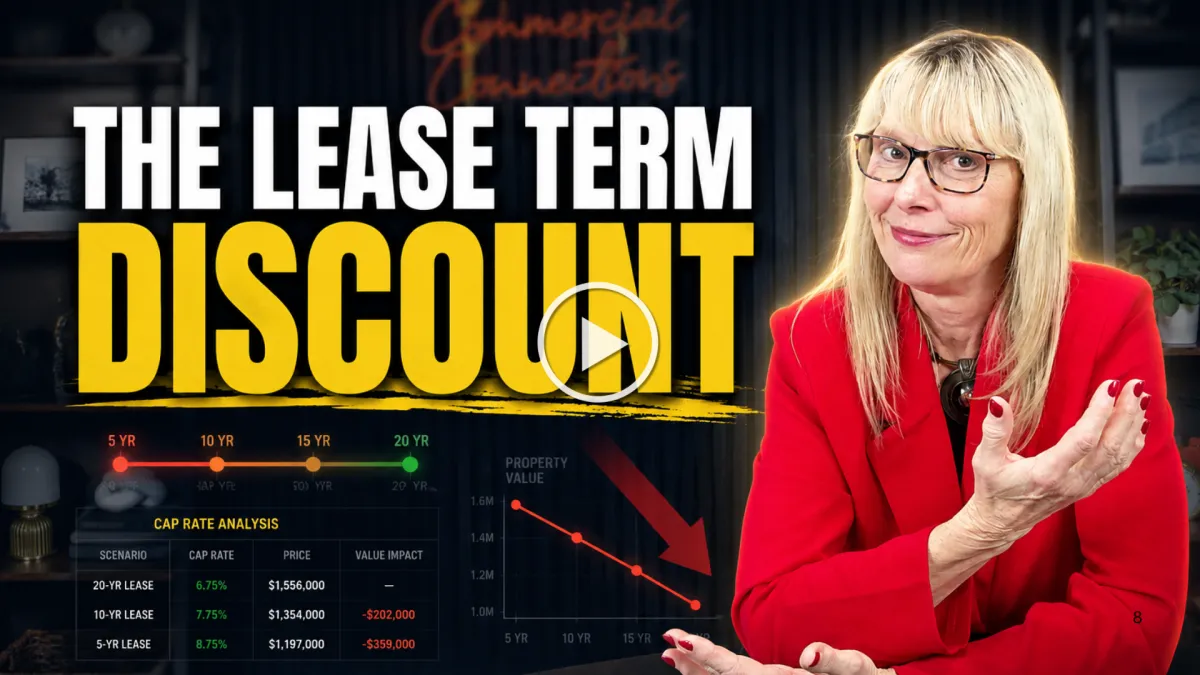
If you’ve been evaluating triple net properties and noticed that two Dollar Generals can look identical on paper but price completely differently, you’re not imagining things. The difference isn’t the building. It’s the lease.
In this episode of Commercial Connections, I walk through three real Dollar General properties I’m currently analyzing — all in the same general region of Texas, all built in the same era, all with the same tenant and lease structure. They started with 15-year leases. They just happen to be at different points in that timeline. And that single variable — how many years are left — is driving meaningfully different cap rates and asking prices across all three.
Cap Rate Is Not Just a Yield Number
Most investors encounter cap rate as a return metric. A 6% cap rate means you’re paying roughly 16.7x the annual rent. A 7% cap rate is a lower price for the same income. But in a triple net context — and especially with dollar stores — cap rate also functions as a risk signal.
As the lease term shortens, cap rates tend to rise. Not because the building has changed. Not because the tenant has changed. Dollar General has been around since the early 1930s. The cap rate moves because the buyer is now closer to a renewal decision they don’t control. Dollar General decides whether to renew. Not you.
Three Properties, Three Scenarios
Here’s how the three properties I’m looking at break down:
Canyon Lake, Texas is priced around a 6.5% cap rate with roughly six years remaining on the lease and annual rent just under $100,000. There’s still meaningful term left, so buyers are willing to pay a premium. They’re buying time.
Liberty, Texas is closer to a 7% cap rate. Same tenant, similar lease structure, slightly lower rent. The higher cap rate reflects a thinner buyer pool. As the clock becomes more visible, fewer investors are comfortable underwriting the renewal risk.
Pointblank, Texas is also around 7%. Same structure, same tenant, same rent level. Nothing about the building has changed. The difference is entirely in how buyers are pricing the next decision point in the lease.
How I Underwrite the Lease Term
My framework for evaluating NNN lease term is straightforward:
→ 10 years or more remaining: buyer focus is on yield and stability. You’re buying income.
→ 6 to 8 years remaining: buyers start asking harder questions. You’re buying time, and the clock is ticking.
→ 5 years or less: the market demands a discount. That discount shows up as a higher cap rate and a lower price.
Cap rate and price move in opposite directions. As the cap rate rises, the price drops. That’s the mechanic. And once you see it clearly, you can’t unsee it.
The Three Numbers That Matter
When you’re reading an offering memorandum for any triple net property, there are three numbers I want you to focus on:
Years remaining on the lease. This tells you how much runway you have before a renewal decision.
Current annual rent. This anchors the income and lets you calculate the implied value.
The cap rate today. This tells you how the market is thinking about risk on this specific deal.
Those three numbers will tell you more than anything else in the package.
What You Can and Can’t Control
You cannot control whether Dollar General renews the lease. That’s their decision, made based on their own business criteria: store performance, demographics, lease economics, distribution logistics. What you can control is how much term you buy and what price you pay for the risk that comes with it.
That’s the entire game in triple net investing. And the clearer you are about where you sit on the lease timeline, the better decision you’ll make.
QUICK NOTE
I own a Dollar General. I bought it because I wanted simplicity and predictability — income that did not depend on constant management decisions. That kind of stability is real, and it is exactly what a well-structured NNN deal can provide.
But the way you get it is not by chasing the highest cap rate. It is by buying the right amount of term for your goals and paying the right price for the risk you are actually taking on.
If you are evaluating a triple net transition as part of a 1031 exchange or a strategic exit from multifamily, I’m glad to walk through the underwriting with you.
Request your Eugene–Springfield Apartment Market Snapshot or your University of Oregon Area Apartment Market Snapshot to see what your current asset is worth and what the transition options actually look like from where you stand.
— René Nelson, CCIM
Principal Broker & Owner, Pacwest Commercial Real Estate
René Nelson, CCIM, is the Principal Broker and Owner of Pacwest Commercial Real Estate, a boutique brokerage in Eugene, Oregon specializing in multifamily and investment property. Licensed since 1989 and CCIM-designated since 2008 — a credential held by fewer than 10% of commercial brokers nationwide — she has guided private and institutional clients through complex 1031 exchanges and strategic exits across the Eugene–Springfield and University of Oregon markets for more than three decades. A multiple-time CCIM Transaction of the Year recipient (2013, 2015, 2020, 2021) and winner of the 2024 Best Overall Transaction of the Year, René is known for turning complex transactions into confident, profitable outcomes — helping owners move from hands-on management to hands-free income while protecting the equity and legacy they’ve spent a lifetime building.
The resources shared here are for informational purposes only and are not financial, tax, or legal advice. Every property and owner’s situation is unique. For guidance tailored to your goals, connect with me directly and we’ll walk through your options together.
Featured
Insights. Advice. Results.
Why I Do This Work: My Philosophy on Multifamily Real Estate and Legacy
René Nelson, CCIM, on the philosophy behind Pacwest Commercial Real Estate — how she helps Eugene multifamily owners sell, exchange, and build lasting legacy.
CCIM Designee since 2008 • Licensed since 1989 •
2024 Best Overall Transaction
© 2026 Pacwest Commercial Real Estate, Inc.
Terms & Conditions | Privacy Policy