Apartment Maintenance: What Buyers See That Owners Miss
Apartment owners rarely lose money on one dramatic failure. They lose it on slow, predictable problems that sat too long.
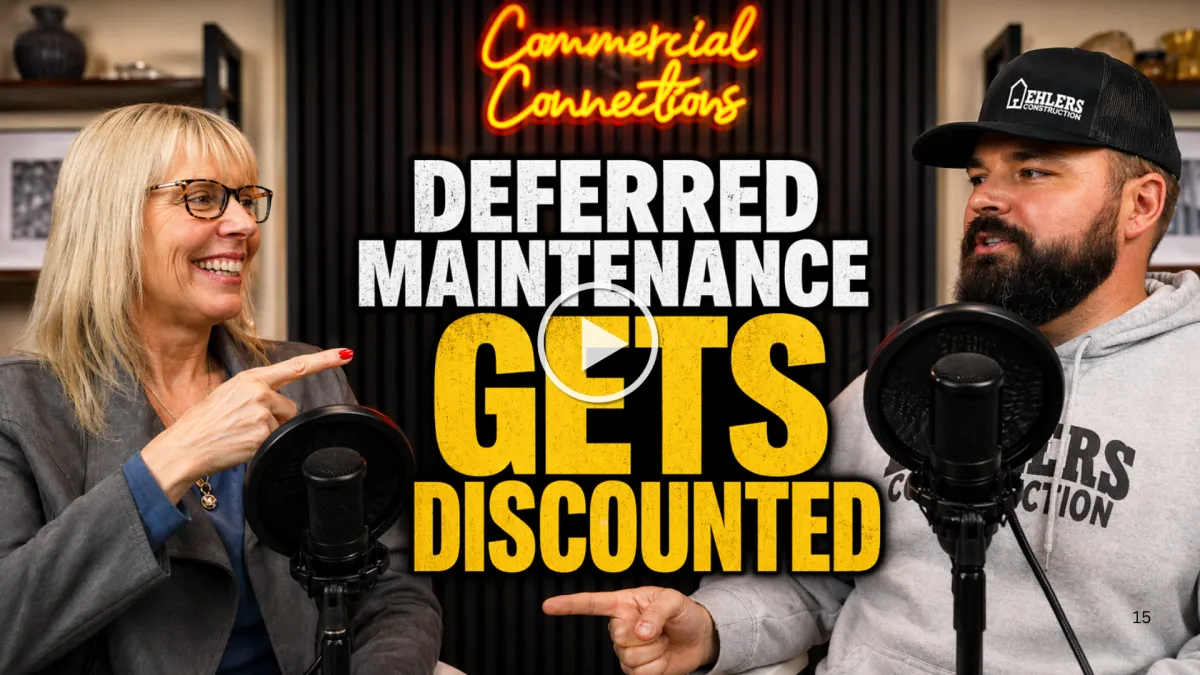
In this episode of Commercial Connections, I sat down with Tanner Drey from Ehlers Construction & Service Group to talk through how deferred maintenance, insurance compliance, hazardous material rules, vendor selection, and labor market pressure all accumulate as ownership costs — and how every one of them shows up in the price a buyer is willing to pay.
Deferred Maintenance Is Not a Delay. It Is a Cost Transfer.
The clearest theme in the conversation with Tanner was this: preventative maintenance is asset preservation. The owners who treat it as optional are not avoiding expense. They are shifting a smaller repair into a larger capital event.
Water intrusion is the most common example. Gutters back up. Fascia begins to rot. Siding softens. Shower waterproofing degrades. Toilet flanges that sit below finish floor level allow leaks to spread underneath flooring before anyone sees a visible sign of damage. None of these start as structural problems. Left alone, most of them become structural problems.
The repair cost at the early stage and the repair cost after years of deferred attention are not in the same range. The later version also tends to involve tenant disruption, extended scope, and higher labor cost because the work is more complex. Waiting almost never improves the math.
Insurance Is Now Setting the Timeline, Not Owners
Insurance pressure has become a real part of the operating equation for apartment owners, and it is one that is catching people off guard. Panel upgrades in particular are landing on owner schedules that are driven by insurer requirements rather than owner planning. What felt like a future budget item can become an immediate requirement.
That dynamic matters beyond the panel itself. Buyers underwrite uncertainty hard. When a property has no inspection history, no maintenance records, and no documented capital schedule, the assumption on the buy side is that hidden issues remain. That assumption gets priced into the offer.
The market does not give credit for work that was probably done. It prices the risk of work that cannot be confirmed. Owners who have maintained documentation — even informally — are in a meaningfully better position than owners who have maintained their properties well but have nothing to show for it.
Execution Risk Starts Before Anyone Picks Up a Tool
One of the more practical points Tanner raised was about hazardous materials. Testing requirements can change how demolition is handled, what disposal protocols apply, and what documentation has to travel with the project. Dumpsters can be tested. The contractor managing the job has to know how to navigate that, and not all of them do.
Vendor selection matters more than most owners realize until a job goes sideways. Tanner’s guidance on bids is worth keeping: get three of them, but do not mistake the lowest number for the best outcome. The bid is just an entry point. What actually determines the cost and timeline of the job is the contractor’s communication, capacity, organization, and ability to solve problems when the unexpected shows up — and it always shows up.
A cheap bid that cannot execute creates delay, change orders, tenant complaints, and operational drag that outlasts the original savings. The contractor you can actually reach when something goes wrong is worth more than the one who gave you the number you wanted to see.
Proactive Ownership Means Sequencing, Not Perfection
No apartment owner can address everything at once. That is not the standard. The standard is having a plan — a documented schedule, realistic reserves, and a sense of what needs to happen in what order.
Annual roof and water-intrusion checks are a reasonable floor. Using inspectors and vendors who understand local insurance expectations means problems get identified against the right standard, not just flagged in isolation. And sequencing matters: panel work, roofing, and unit upgrades that collide with each other — or with high-occupancy periods or a planned sale timeline — cost more and take longer than the same work done in the right order.
Labor and material inflation add pressure to the waiting calculus. The construction workforce is shrinking. Costs move in one direction. An owner who defers a repair today is not locking in today’s price. They are betting that future conditions will be more favorable, and the data does not support that bet.
What This Means at the Closing Table
Buyers, insurers, and contractors all see deferred work differently than owners do. An owner who has lived with a slow-draining gutter for three seasons sees a manageable nuisance. A buyer’s inspector sees a water intrusion risk that goes into the report. A buyer’s broker sees a negotiating point. And a buyer’s lender may see a condition that has to be resolved before funding.
Preventative maintenance is not a side issue. It is part of pricing, operations, and exit strategy. The owners who protect value best going into a sale are the ones who treated maintenance as a financial decision, not a facilities decision.
If you are thinking about a sale in the next one to three years and want to understand how your property’s condition is likely to be perceived by buyers in today’s market, I’m glad to walk through it with you. Schedule a confidential Pinpoint Price Evaluation and we’ll look at where you stand and what, if anything, is worth addressing before you go to market.
— René Nelson, CCIM
Principal Broker & Owner, Pacwest Commercial Real Estate
René Nelson, CCIM, is the Principal Broker and Owner of Pacwest Commercial Real Estate, a boutique brokerage in Eugene, Oregon specializing in multifamily and investment property. Licensed since 1989 and CCIM-designated since 2008 — a credential held by fewer than 10% of commercial brokers nationwide — she has guided private and institutional clients through complex 1031 exchanges and strategic exits across the Eugene–Springfield and University of Oregon markets for more than three decades. A multiple-time CCIM Transaction of the Year recipient (2013, 2015, 2020, 2021) and winner of the 2024 Best Overall Transaction of the Year, René is known for turning complex transactions into confident, profitable outcomes — helping owners move from hands-on management to hands-free income while protecting the equity and legacy they’ve spent a lifetime building. The resources shared here are for informational purposes only and are not financial, tax, or legal advice. Every property and owner’s situation is unique. For guidance tailored to your goals, connect with me directly and we’ll walk through your options together.
Featured
Insights. Advice. Results.
Why I Do This Work: My Philosophy on Multifamily Real Estate and Legacy
René Nelson, CCIM, on the philosophy behind Pacwest Commercial Real Estate — how she helps Eugene multifamily owners sell, exchange, and build lasting legacy.
CCIM Designee since 2008 • Licensed since 1989 •
2024 Best Overall Transaction
© 2026 Pacwest Commercial Real Estate, Inc.
Terms & Conditions | Privacy Policy